Are White Pebbles Good for the Garden? Uses, Soil & What to Put Under Them
White pebbles are excellent in the right bed and a nuisance in the wrong one. Here is when they earn their keep in a UK garden, whether you can tip them on soil, what must go underneath, and when gravel is the smarter texture.
Are white pebbles good for the garden? Yes — as a designed surface, not as a bag tipped on mud. Used on membrane, at the right depth, in light and air, they brighten small courtyards, frame planting, dress pots and make a formal path read Mediterranean rather than municipal. Tipped straight on soil they sink, stain and sprout weeds, and then people decide “white pebbles were a mistake”.
This page is the landscaping half of the do white pebbles discolour cluster: can I put pebbles directly on soil, what do you put under pebbles in the garden, which is better — pebbles or gravel, what are the best uses for white pebbles, and what are the best pebbles for my garden. Maintenance and yellowing live on their own pages; here we decide whether to use them at all.
The stone we specify when the answer is yes is Snow-White Thassos Marble Pebbles — a true white that still looks white when wet — with Natural Stone Sealer on outdoor beds. Browse the wider white pebbles and gravel collection or start with a sample in the exact corner you have in mind. Light is local. The same bag looks different against red brick and against grey render.
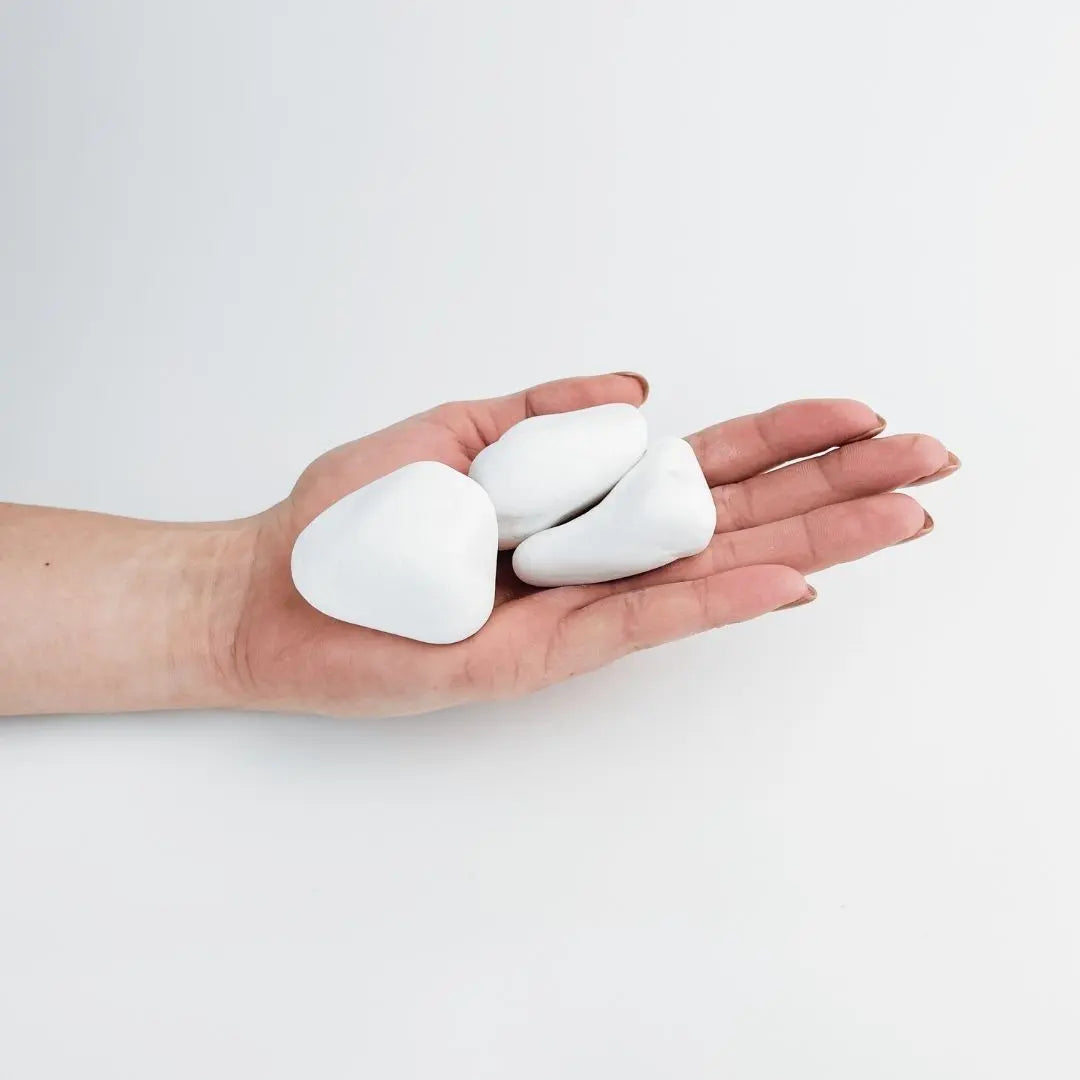
Garden-use kit

- Best stone
- Thassos marble
- On bare soil?
- No — membrane first
- Underlay
- 95gsm+ woven + optional sub-base
- Pebbles vs gravel
- Pebbles for beds; gravel for tight joints
- Depth
- 40–50 mm typical
- Finish
- Invisible sealer
Are White Pebbles Good for the Garden? Honest Pros and Cons
White pebbles are a high-contrast finishing material. They do three jobs well: reflect light, define edges, and make green planting look greener. They do three jobs badly: hide neglect, sit on wet clay without prep, and pretend to be a no-maintenance surface in a dripping shrubbery.
| They are good when… | They are a poor choice when… |
|---|---|
| You want a courtyard or border to feel larger and brighter | The only space you have is deep shade under evergreens |
| You will lay membrane, edge the bed and keep leaves off | You want to tip a bag on soil and walk away for five years |
| The stone is a true white (Thassos, good Carrara) | The budget stone is grey-cream and you expected Pinterest white |
| Traffic is light — looking, pottering, occasional feet | It is the dog-run, the bin path, or a clay bog |
| You like a Mediterranean, Japanese or memorial aesthetic | You need a play surface or a wheelchair-smooth path |
What they actually do for plants
A pebble mulch suppresses weeds (with membrane), slows surface evaporation, and keeps mud off foliage after rain. White stone reflects light back into a shady shrub and can slightly warm a south-facing wall. It can also bounce glare into a living-room window and, on a low roof or metal shed, add a surprising amount of reflected heat. Place the brightest white where you want light, not where you sit in July at noon with no hat.
Around stems, keep a small collar of bare soil or a softer mulch if you are planting things that resent a hot, dry neck — some hydrangeas and newly planted trees prefer it. Pebbles are a surface, not a substitute for compost in a planting pit.
The one-sentence verdict: white pebbles are good for the garden if you treat them as paving you can pour — prep, edge, depth, the right stone — and not as a decorative afterthought. Snow-White Thassos is the grade that makes that effort look expensive rather than dusty.
What Are the Best Uses for White Pebbles?
Use white pebbles where the eye stops, not where the wheelie bin travels. These are the placements that earn the cost of a proper marble.
| Use | Why white works | Size to specify |
|---|---|---|
| Formal borders and parterres | Crisp contrast against yew, box, lavender, black mondo | 30–60 mm |
| Narrow side returns and courtyards | Bounces light; makes a dank alley feel wider | 30–60 mm pebbles or Thassos gravel |
| Pot and planter toppings | Stops compost splash, looks finished, stays white indoors | 10–30 mm |
| Water-feature surrounds (not in the fish pond) | Reads Mediterranean; hides the liner edge | 30–60 mm or 60–100 mm |
| Memorials and graves | Quiet, bright, easy to lift and wash | 10–30 mm or 30–60 mm |
| Japanese-inspired dry gardens | Raked gravel or placed pebbles as negative space | Gravel to rake; 60–100 mm as placed stones |
| Stepping-stone joints and patio pockets | Softens flags without a full gravel garden | 10–30 mm or 30–60 mm |
| Indoor displays, hearths, bathroom jars | Zero algae, maximum white | 10–30 mm |
Uses to skip or think twice about: a children’s play corner (rounded stone is still a trip and a thrown missile), a steep bank with no edge (pebbles migrate), a clay hollow that ponds all winter (everything will slime), and the strip under a dripping Leylandii (you will be on the yellowing page by November). Darker border stones exist for those jobs.
White pebbles also work as a thin bright line — a 30 cm ribbon against a fence or path — rather than a whole garden resurfaced. A little true white does more than a lot of grey-white. That is how to use a premium stone without pretending you have a Greek terrace budget for 80 square metres.
Can I Put Pebbles Directly on Soil?
You can. You should not. Pebbles on bare soil sink, mix with mud, stain from underneath, and let every weed seed in the topsoil come up through the gaps. White pebbles make all four failures obvious within a season. The bag-on-soil method is how garden-centre white stone gets a bad name.
What happens on bare soil, in order:
- Rain punches fines up between the pebbles. The bed looks dirty from below, which is the stain people then try to vinegar off.
- Frost and worms lift and drop the surface. Depth becomes patchy. Soil shows. Cats discover the soft spots.
- Weed seeds germinate in the collected silt. You now have a white bed with dandelions, which is a look, just not the one you ordered.
- To “freshen it up” you buy another bag and tip it on top. The mess is now deeper and still dirty.
The only time pebbles-on-soil is acceptable is a temporary pot, a vase, or a week-long styling job you will pick up again. For anything that should still look intended next April, prepare the ground. The full weekend method is in how to lay decorative stones; the white-stone version of the underlay question is the next section.
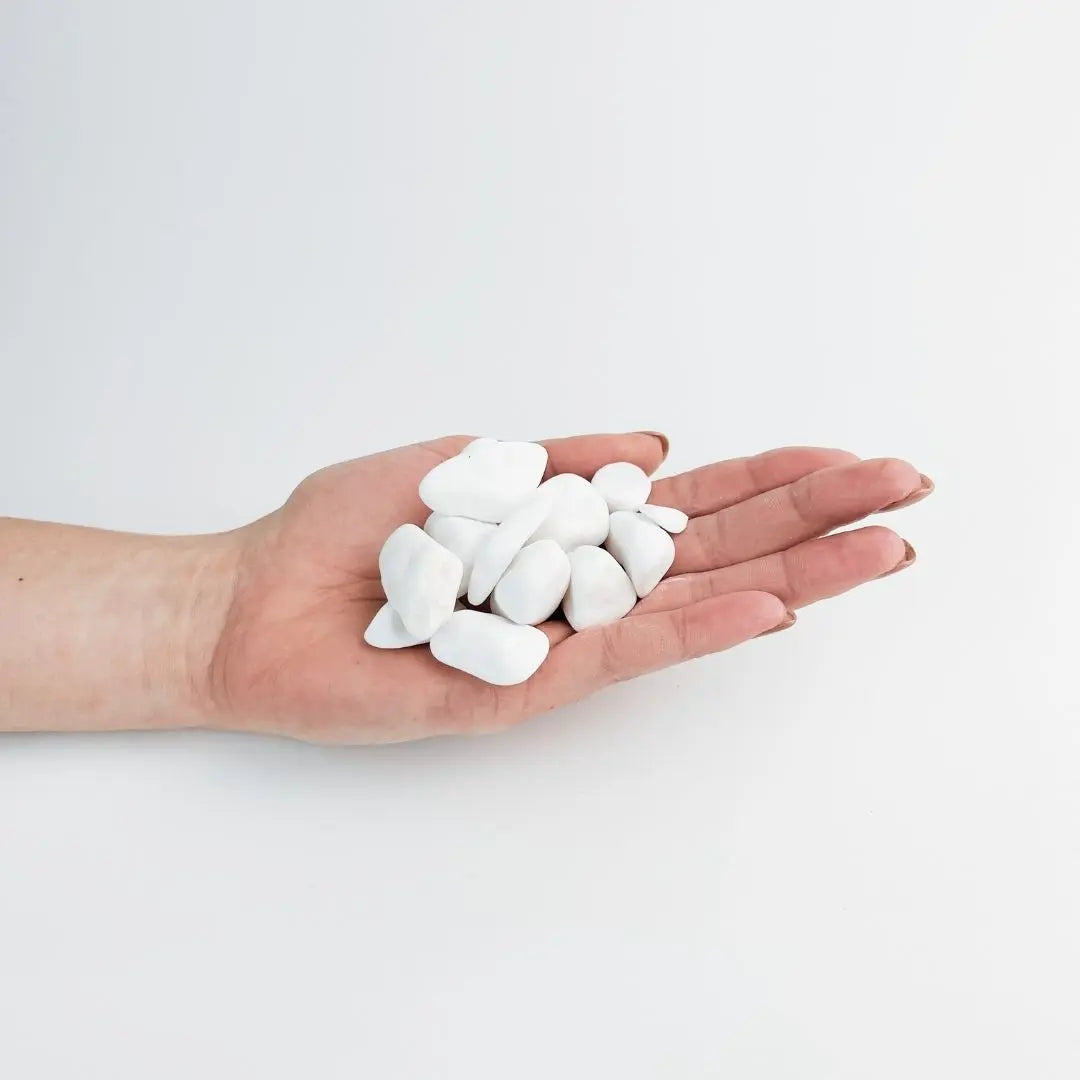
Soil contact is the main reason white marble goes brown at the edges. The stone is not failing. The groundwork is.
If your current bed was tipped on dirt, the repair is: lift what you can save, scrape back to soil, compact, membrane, edge, then re-lay plus a top-up of Thassos. Washing alone will not beat wicking mud.
What Do You Put Under Pebbles in the Garden?
Under white pebbles you put a draining stack, not a plastic sheet and a prayer. From the soil up:
- A level, compacted, slightly falling formation. Strip turf and roots. On heavy clay that ponds, add 25–50 mm of compacted MOT Type 1 or sharp drainage aggregate so you are not laying marble on soup.
- Weed-control membrane, 95gsm or heavier woven. Not the flimsy 50gsm that tears when you kneel on it. Overlap joins 150 mm, pin with galvanised U-pins, tape if you are fussy. For pale stone, 125gsm is worth it — it lasts, and it blocks more soil colour from ghosting through a thin bed.
- Edging that actually retains. Steel, stone, brick, or treated timber, proud enough that pebbles cannot migrate onto the lawn. An edge is part of the underlay system: without it the membrane curls and soil sneaks in.
- The pebbles, 40–50 mm deep for 30–60 mm stone (about 80–100 kg per m²). Shallower looks mean and lets membrane wink through. Deeper wastes money unless you want a cobble feel with 60–100 mm.
- Optional: invisible sealer once the stone is clean and dry — Natural Stone Sealer — so the underlay’s work is not undone by tannins from above.
| Underlay choice | Use it when | Skip it when |
|---|---|---|
| 95gsm woven membrane | Most borders, pots (cut to fit), memorials | Never skip on outdoor white stone |
| 125gsm+ woven | Pale marble, long life, light foot traffic | A pot you re-dress every year |
| MOT Type 1 + membrane | Clay, paths, anything that must stay level | A shallow decorative ribbon on already-drained ground |
| Sand bed | Paving, not loose pebbles | Under tumbled marble — sand pumps up and stains |
| Cardboard / old carpet | Never for a finished white bed | Always — they rot, smell and stain |
Do not use sand as a blinding layer under white marble. It migrates, stains, and looks like the beach after a storm. Do not use impermeable pond liner under a whole border unless you have designed drainage elsewhere — you will create a pebble bath that greys and slimes. Membrane must be permeable. Water should leave. Dirt should not arrive.
Around plants, cut an X in the membrane, plant, fold back. Do not leave a wide disk of bare soil “for watering” on a white pebble bed unless you like a brown halo. Water the rootball at planting and then let the pebble mulch do its job.
Which Is Better, Pebbles or Gravel?
Neither is universally better. They are different tools. Pebbles are rounded, larger, and sit as individual objects. Gravel is smaller, often more angular (unless it is a pebble-gravel), and reads as a texture or a poured surface.
| White pebbles | White gravel | |
|---|---|---|
| Look | Sculptural, coastal, each stone visible | Fine, formal, “dressed” surface |
| Underfoot | Ankle-roll if too large on a path; fine at 30–60 mm for pottering | Easier to walk if angular and compacted; rounded gravel still shifts |
| Cleaning | Rinses and batch-washes well | Holds leaf mash in the joints; more surface to stain |
| Weeds | Fewer niches if deep enough | Silt collects; weeds if membrane fails |
| Best white options | Thassos pebbles, Carrara pebbles, quartz | Thassos gravel, Carrara gravel |
| Choose when | Borders, features, pots, water, memorials | Tight paving joints, raked gardens, a continuous pale carpet |
For most home gardens asking this question next to a photo of white marble, pebbles are the better white. They stay visually cleaner, they are what people mean by “Mediterranean pebbles”, and they are what Snow-White Thassos is sold as. Choose gravel when you need the stone to pack into a narrow joint or you want to rake a pattern.
Do not use rounded pebbles as a structural base under a shed or hot tub. That is a job for angular aggregate. Decorative white stone goes around the object, not under the load. See pebbles around a hot tub if that is the project.
A mixed specification is allowed and often looks more expensive: 30–60 mm pebbles in the open bed, a finer gravel in the 40 mm strip against the house wall, a few 60–100 mm cobbles as placed objects. Same mineral, three textures, one delivery from Stones4Gardens.
What Are the Best Pebbles for My Garden?
The best pebble is the one whose colour, size and mineral match the job. For white, that almost always means starting with Thassos and only stepping off it for a reason.
- Brightest true white, outdoor or indoor — Snow-White Thassos Marble Pebbles. 10–30 mm for pots and tight edges, 30–60 mm for the default border and path, 60–100 mm for features and cobble beds. This is the stone that still looks white when wet.
- White with a little grey vein, slightly more forgiving of dust — Bianco Carrara pebbles or Carrara gravel. Classic, a hint of movement in the face, still a proper marble.
- Harder, less porous pale — white polished quartz. Not as luminous as Thassos; tougher in neglect and in some water features.
- Not white, but the right pebble if you have given up on pale — mid greys and charcoals from the rest of the Stones4Gardens range. Use them where the dog runs and keep Thassos for the view from the kitchen.
Size rules of thumb, expanded in what size pebbles for garden: smaller than 20 mm migrates and sticks to shoes; larger than 80 mm is a placed object, not a poured surface. 30–60 mm is the garden default for a reason.
Do white garden stones stay white if you pick the best pebble? They stay white on the terms in why white rocks turn yellow and the pillar discolour guide: sun, membrane, leaves, sealer, honest stone. The best pebble cannot outrun a dripping hedge and a missing underlay. It can make the hours you do spend look like a designed garden rather than a cleanup.
Always sample. A 1 kg bag wet on your actual soil, against your actual brick, in your actual afternoon light, is worth more than any web photo — including ours. Order two whites if you are torn between Thassos and Carrara. Live with them for a week. Then scale up with the calculator on this page so the Stones4Gardens basket is the size you need, not the size a guess produced.
A White-Pebble Installation Checklist (Weekend Order)
If you have decided white pebbles are good for this garden, install them like a surface, not like a mulch you might change your mind about.
- Sample in situ. Wet and dry. Morning and afternoon. Against the wall colour.
- Measure and calculate. Length × width × depth. 40–50 mm depth, ~80–100 kg/m², plus 10%. Use the calculator below — it packs bags and sealer and applies the PebbleFinder code.
- Clear and compact. Turf off, roots out, slight fall away from the house, tamper or plate on anything you will walk on.
- Drain if you are on clay. A thin MOT or drainage layer now is cheaper than a yellow slime next February.
- Edge first, then membrane. Pins every 300 mm at edges. Overlaps 150 mm.
- Pour, spread, do not dump in one heap that scours the membrane. Rake to a consistent depth. The last bag is for topping thin corners.
- Walk it, look from the window, adjust. White shows every dip.
- When the stone is clean and dry, seal. Invisible finish, not wet-look. Method: sealing garden stones.
- Write the maintenance into the year. Leaf-blow in autumn, hose in spring, wash when it needs it. That is how white pebbles stay a good idea.
Delivery for Stones4Gardens bagged stone is straightforward on a driveway. Bulk still needs a place to land that is not the new membrane. Stage bags on boards, then decant. If you are dressing a front garden, warn yourself that the first hour looks worse than the last — white dust, cut membrane, half an edge. Finish the edge. The photos happen after the broom.
Cost, Coverage and When Not to Bother
White marble pebbles cost more per bag than a mixed flint from a builders’ merchant. They should. You are buying colour that photographs and a mineral that cleans back. The way to keep the bill sane is to use Thassos where it is seen and a cheaper mid-tone where it is not — not to buy a fake white for the hero bed and then spend three years trying to bleach it.
Coverage, again: 80–100 kg per m² at 40–50 mm for tumbled pebbles. A 10 m × 0.4 m border is 4 m², so roughly 320–400 kg plus 10%. The calculator converts that into the cheapest mix of 10, 20, 100 kg (and larger) bags and drops them in a Stones4Gardens checkout with sealer if you want it. Samples start at £6.99; the 5 L sealer is £54.99 and covers a typical domestic border.
Skip white pebbles — without guilt — when the brief is a play lawn, a deep wet shade, a farm gateway, or a client who has said the words “zero maintenance” and means it. Recommend a darker angular gravel or planting instead. White stone is a good garden material for people who like looking after a surface a little, the way they might wipe a worktop. It is a bad material for people who want to forget a surface exists.
If you are still on the fence, that is what the sample is for. Put Thassos on the soil for a fortnight. If you keep walking over to look at it, specify the bed. If it already looks like a chore, pick another stone. Honesty at 1 kg is cheaper than regret at 400 kg.
Specify the bed — 10% off at checkout
Enter the area you will actually prepare. We pack Thassos plus enough invisible sealer into one Stones4Gardens cart.
Typical border is about 40 cm wide — just type the length.
Width is pre-filled for a typical garden border— change it if yours is different.
Fine-tune size, depth and extra stone
Paths, garden borders, pool surrounds
Pick what you’re covering, then enter the size. We’ll pack the bags and sealer for you.
The pebbles — and the sealer — worth laying properly
Snow-White Thassos Marble Pebbles from £6.99 a sample, and Natural Stone Sealer at £54.99 for 5 L. Every card is a live Stones4Gardens product page.

Snow-White Thassos Marble Pebbles — 10/30 mm
10/30 mm · Sample
Snow-White Thassos Marble Pebbles — 30/60 mm
30/60 mm · Sample
Snow-White Thassos Marble Pebbles — 60/100 mm
60/100 mm · Sample
Natural Stone Sealer & Water Repellent
5 L · Invisible finishPro tips
Treat pebbles as paving you pour
Formation, 95gsm+ membrane, a real edge, 40–50 mm depth. Tipping Thassos on soil is how a good stone gets a bad reputation.
Use true white where the eye stops
A metre of Snow-White Thassos against planting does more than a whole garden of grey-cast gravel. Spend the marble on the view.
Pebbles for beds, gravel for joints
Rounded pebbles stay cleaner and read more expensive. Fine gravel belongs in tight paving gaps and raked surfaces — Thassos gravel if you still want the same white.
Sample against your brick, not the website
Wet a sample on the actual bed. South-facing render and north-facing fence disagree about what ‘white’ means.
Frequently asked questions
Are white pebbles good for the garden?
Yes, as a prepared surface in reasonable light: they brighten space, set off planting and need less work than a lawn if you lay membrane and keep leaves off. They are a poor choice on bare soil, in dripping shade, or if you bought a grey-cast stone and expected a true white. Snow-White Thassos is the grade that makes the effort look right.
Can I put pebbles directly on soil?
Not if you want them to stay clean, level or weed-free. On bare soil they sink, stain from below and sprout weeds. Compact the ground, lay 95gsm+ woven membrane, edge the bed, then put the pebbles on. Pots still need a liner so stone does not vanish into compost.
What do you put under pebbles in the garden?
A compacted, draining formation, then heavy woven weed membrane (95gsm, or 125gsm under pale marble), then a proper edge, then 40–50 mm of pebbles. On clay add a thin drainage or MOT layer first. Do not use sand, carpet or cardboard under white stone.
Which is better, pebbles or gravel?
Pebbles for borders, pots, features and a cleaner look; gravel for tight joints and raked or continuous fine textures. For a white garden surface, pebbles usually stay visually cleaner. Use Thassos pebbles and Thassos gravel if you want both in the same colour.
What are the best uses for white pebbles?
Formal borders, brightening courtyards and side returns, pot toppings, water-feature surrounds (not fish ponds), memorials, Japanese dry gardens, and indoor displays. Avoid play areas, steep un-edged banks, and deep wet shade.
What are the best pebbles for my garden?
For white, start with Snow-White Thassos in 30–60 mm unless you are topping pots (10–30 mm) or placing cobbles (60–100 mm). Choose Carrara if you want a little grey vein, quartz if you want a harder, less porous pale. Sample in your light before you order bulk.
Do white garden stones stay white?
They stay white if the stone is truly white and you give them sun, membrane, leaf-clearing and sealer. They will not stay showroom-white under trees on bare soil. See do white pebbles discolour and why white rocks turn yellow.
Do white pebbles help with drainage?
They are a free-draining surface, not a drainage system. Water still needs somewhere to go. On clay, put a drainage layer under the membrane or the bed becomes a pebble puddle that slimes. Do not use impermeable liner under a whole white border.
Are white pebbles safe around plants and pets?
Yes as a mulch and path, with a plant collar where stems hate a hot dry neck. They are uncomfortable to lie on and easy to flick, so they are a poor play surface. Keep cleaning chemicals — especially bleach — off the bed if pets walk there; wash lifted stone in a bucket instead.
How much do I need and what will it cost?
Budget 80–100 kg per m² at 40–50 mm, plus about 10%. Use the calculator on this page to pack Thassos bags and optional sealer into one discounted Stones4Gardens basket. Samples from £6.99 let you check the colour before you scale up.
Related guides
Do White Pebbles Discolour? How to Keep Them White & Stop Them Going Green
Yes — outdoor white pebbles discolour from algae, leaves and soil, not because the stone itself changes colour. How to stop it, plus the Thassos marble and invisible sealer that stay brightest in UK gardens.
Read guide →
Why Are My White Rocks Turning Yellow? (And Do White Pebbles Stay White?)
Why white rocks turn yellow, whether white pebbles stay white, and if white rock is hard to keep clean. Diagnose tannins, iron and algae — then get them white again.
Read guide →
How to Lay Decorative Stones in Your Garden: Step-by-Step
Step-by-step guide to laying decorative stones in your UK garden: ground prep, membrane, depth by stone size (with Stones4Gardens product examples), edging and stepping stones.
Read guide →
Types of White Garden Stones Compared: Which White Pebbles, Gravel or Chippings to Buy
Compare white garden stones — marble, spar, limestone, granite, quartz and dolomite, plus pebbles vs gravel vs chippings. Which is whitest and best value?
Read guide →
How to Clean White Garden Stones with Vinegar (and When You Must Not)
Can you clean white garden stones with vinegar or bleach? What vinegar does to marble, limestone and granite — plus safer ways to make stones look new again.
Read guide →
If white pebbles are the right call, specify a white that is actually white. Shop Snow-White Thassos Marble Pebbles in 10–30 mm, 30–60 mm or 60–100 mm, add Natural Stone Sealer, or start with a sample. The calculator builds the Stones4Gardens basket at 10% off.