How to Clean White Garden Stones with Vinegar (and When You Must Not)
Vinegar is the internet’s favourite garden-stone cleaner — and the fastest way to etch white marble. Here is what acetic acid actually does to natural stone, when bleach is safer, and the method that makes stones look new again without ruining them.
How do you clean white garden stones with vinegar? Search forums and you will see the same recipe: a 1:1 white-vinegar spray, a stiff brush, a hose. It works on some rocks. On the white pebbles most UK gardens actually buy — marble, limestone, dolomite — it is the wrong chemistry. Vinegar is a mild acid. Calcite stone is an alkali mineral. They cancel each other out, and the “clean” you get is a permanently dulled, chalky surface that never looks new again.
This page answers the household-cleaner questions the general how to clean white pebbles guide only sketches: what will vinegar do to natural stone, what shouldn’t you use white vinegar on, can I use bleach to clean garden stones, and what is the best thing to use to clean rocks. The short version: match the cleaner to the mineral, not to the stain.
If the stone underneath is a true white — Snow-White Thassos Marble Pebbles from Stones4Gardens — a stone-safe wash plus Natural Stone Sealer & Water Repellent brings the brightness back and keeps the next season’s film sitting on top instead of soaking in. If you are not sure what you have, order a 1 kg sample of Thassos, wet it next to your existing bed, and you will know in ten minutes whether you are cleaning dirt or fighting the rock itself.
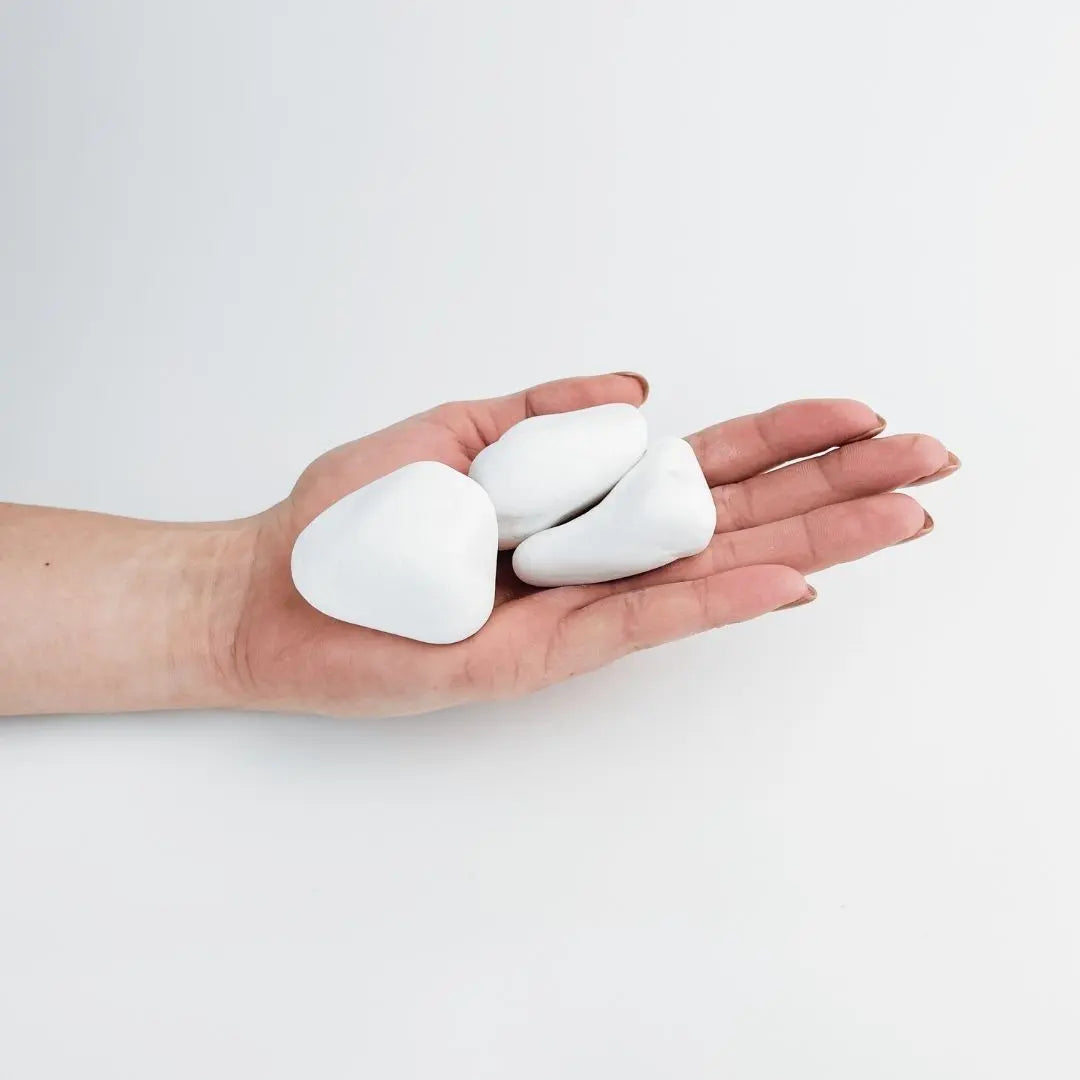
Cleaner cheat sheet

- Marble / limestone
- Never vinegar or brick acid
- Granite / quartz
- Dilute vinegar is optional
- Best outdoor clean
- Stone-safe algae remover
- Indoor / lifted stone
- Dilute bleach, then rinse
- Aftercare
- Invisible 5 L sealer
- Reference stone
- Thassos marble
Can You Clean White Garden Stones with Vinegar?
Sometimes — and often you should not. Distilled white vinegar is roughly 5% acetic acid in water. That acid dissolves calcium carbonate. Most bright white garden stones sold in Britain are calcium-carbonate rocks: marble, limestone, travertine, some dolomites. Spray vinegar on those and you are not lifting dirt. You are dissolving the face of the stone, a few microns at a time.
The result looks “clean” for a day because the etched surface scatters light and the organic film has been loosened. A week later the same bed looks chalkier, more porous, and greener than before — because a rougher, more open surface holds water and algae even better. That is why people who “cleaned with vinegar” often search next for how to get white garden stones white again.
| Stone you have | Vinegar? | Why | Use instead |
|---|---|---|---|
| White marble pebbles (Thassos, Carrara) | No | Calcite — acid etches and dulls | Stone-safe algae cleaner, then seal |
| White limestone / chalky gravel | No | Same mineral family as marble | Hose + pH-neutral patio cleaner |
| Dolomite / “polar white” gravel | No | Acid-sensitive; often already grey-cast | Rinse; replace if still grey when dry |
| White granite / quartz pebbles | Sparingly | Silica-rich — acid does not etch the rock | Dilute vinegar on lifted stone, then rinse |
| Slate, sandstone, terracotta | Avoid | Can fade, leave marks, or open pores | Stone-labelled cleaner only |
If you bought Snow-White Thassos or Bianco Carrara white gravel, treat vinegar as a kitchen cleaner, not a garden one. Those stones clean back to white with water, a wide-fan rinse and a product written for natural stone. That is the method in our cleaning guide — this page is the chemistry behind why people reach for vinegar, and why they regret it on marble.
What Will Vinegar Do to Natural Stone?
Acetic acid reacts with calcium carbonate to make calcium acetate, water and carbon dioxide. In a kitchen sink that fizz is satisfying. On a garden pebble it is the stone giving up its polished face. You will not always see bubbles — outdoor vinegar is dilute, and the reaction can be slow — but the damage is cumulative.
What you will notice
- Loss of sheen. Tumbled marble has a soft satin. After vinegar it reads matt and dusty, even when dry.
- A chalky white bloom. That is not a clean. It is a micro-etched surface holding mineral residue.
- Faster re-soiling. Opened pores drink leaf tannin, soil water and algae food. The next stain arrives sooner.
- Uneven patches. Vinegar pools in hollows. Those spots etch deeper and look mottled forever.
On silica stone — granite, quartzite, many river quartz pebbles such as white polished quartz — vinegar does not attack the mineral. It can loosen limescale, hard-water crust and some organic film. Even then it is optional, not best. A pH-neutral stone cleaner does the same job without the smell, the plant risk, or the chance you have mis-identified the rock.
The two-minute identification test. Put one drop of white vinegar on a spare pebble you do not mind sacrificing. If it fizzes, whispers, or the wet spot dries duller than the rest, it is calcite (marble or limestone). Do not vinegar the bed. If nothing happens after a minute, you may have granite or quartz — still rinse thoroughly, and still prefer a labelled outdoor cleaner in planted beds.
People also ask what vinegar does to the garden, not just the stone. Residual acetic acid lowers soil pH in a thin band, stresses lime-loving plants (lavender, clematis, lilac), and is unkind to worms and soil bacteria at the concentration hobby blogs recommend. That is a second reason not to spray a whole border “because it is natural”.
What Shouldn’t You Use White Vinegar On?
White vinegar is a useful descaler for kettles and a decent glass wipe. It is a poor universal cleaner. In a garden and around the house, keep it off these surfaces — the list is longer than most viral posts admit.
| Do not use white vinegar on | What happens |
|---|---|
| Marble, limestone, travertine, onyx | Etches, dulls, opens pores — including white garden pebbles |
| Cement, concrete, mortar, grout | Eats the lime binder; joints crumble; paving looks eaten |
| Natural stone sealers (once applied) | Strips or undermines impregnators; you pay twice |
| Aluminium, cast iron, some stainless | Pitting and dulling on garden furniture and edging |
| Egg-based or waxed stone, honed floors | Strips finish; indoor marble worktops included |
| Ponds, rills, and anything near fish | pH crash — see fish-friendly pebbles |
| Electronic irrigation controllers, stone with iron staining | Acid can set rust marks rather than lift them |
The garden-specific rule of thumb: if the stone would fizz with a drop of acid, vinegar is the wrong bottle. That covers almost every “bright white” decorative pebble sold for UK borders, including our Thassos marble and Snow-White Thassos gravel. Use vinegar on a kettle. Use a stone-safe cleaner on the stones.
Household extras people mix with vinegar — washing-up liquid, salt, lemon juice, bicarbonate — do not make the acid safer on marble. Salt is abrasive. Lemon is more citric acid. Bicarbonate plus vinegar is a science-fair foam that cancels both products into salty water. None of those hacks restore white marble. They either etch it or waste an afternoon.
How to Clean White Garden Rocks with Vinegar — Only If the Stone Allows It
If your fizz test was negative and you are dealing with granite, quartz or a confirmed silica gravel, a vinegar wash can be a reasonable one-off for limescale or a tea-coloured organic film. Do it on lifted stone, not as a border spray, so run-off never hits planting or marble nearby.
You will need
- Distilled white vinegar and a plastic bucket (not metal)
- A garden sieve or colander, stiff nylon brush, gloves, eye protection
- A hose with a spray nozzle, and a tarp for drying
The method
- Lift a manageable batch. Scoop pebbles into the sieve. Cleaning on the soil just drives dirty vinegar into the bed.
- Rinse first. Hose until the water runs clearer. Vinegar should meet dirt, not a mud slurry.
- Mix weak, not kitchen-strength. One part vinegar to three parts water is plenty for silica stone. Stronger is not cleaner; it is just smellier and harder on plants if any splash escapes.
- Soak 10–15 minutes, not hours. Agitate with the brush. Do not leave stone sitting in acid all afternoon.
- Rinse until you cannot smell vinegar. Residual acid keeps working after you walk away.
- Dry in the sun, then decide. If the rock is bright, re-lay over fresh membrane. If it is still yellow or grey, the colour is in the stone — see why white rocks turn yellow.
Never combine vinegar and bleach. The mix produces chlorine gas. If you have already bleached a batch, rinse it completely and wait until no chlorine smell remains before any acid product goes near it.
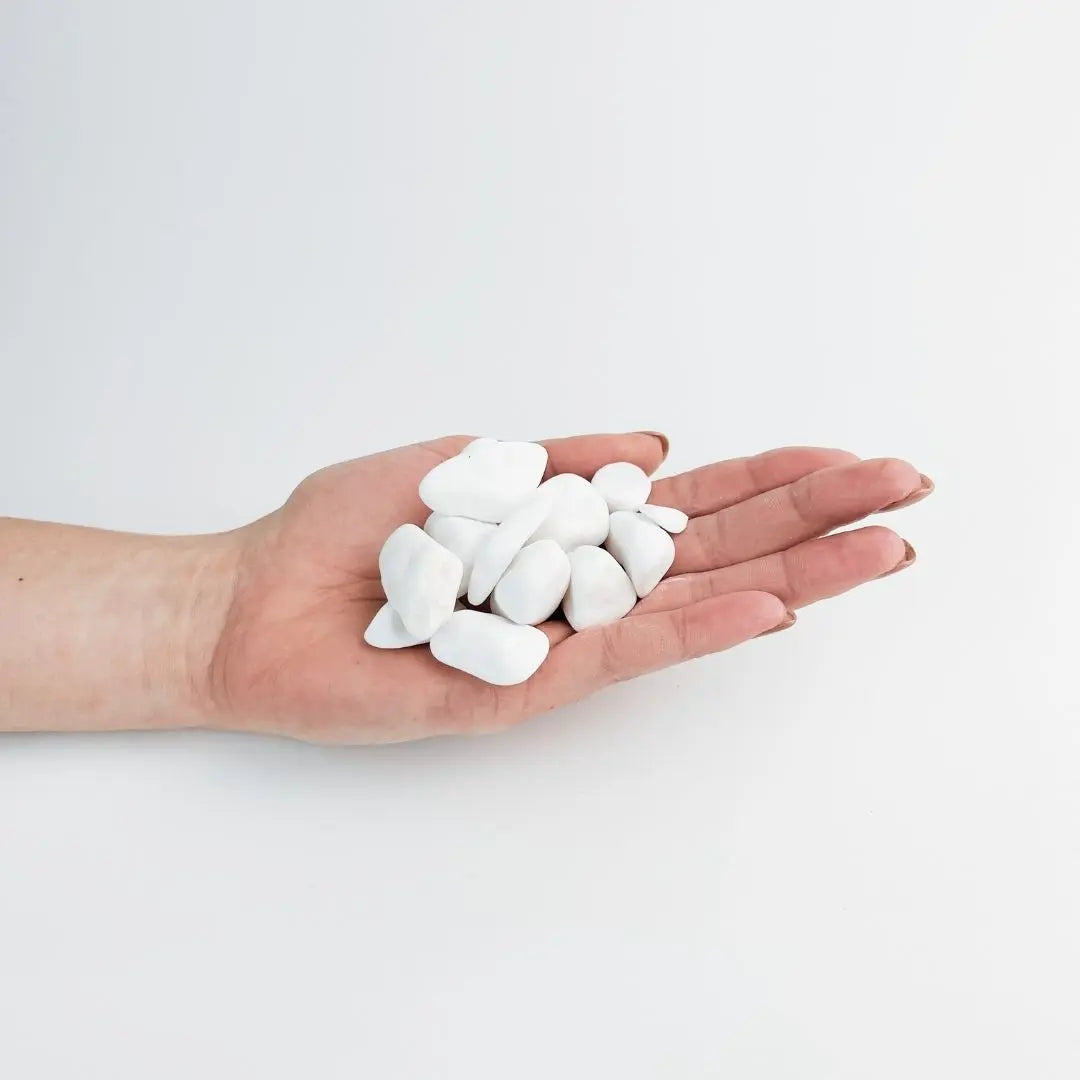
Pots, memorials and thin borders are where household recipes do the most damage, because people treat a handful of pebbles like washing-up. Lift them, yes. Acid-wash marble, no.
A bucket of warm water, a nylon brush and a labelled patio or algae cleaner restores 10–30 mm Snow-White Thassos without etching. Dry the batch, then a light coat of invisible sealer while the stones are still easy to turn.
Can I Use Bleach to Clean Garden Stones — and How?
Yes, with limits. Household sodium-hypochlorite bleach oxidises organic stains: algae green, leaf tannin yellow, bird-lime marks. It does not dissolve calcite the way vinegar does, so it is chemically kinder to marble than acid. It is not kinder to soil life, worms, pets, ponds or nearby foliage. That is the trade-off.
| Situation | Bleach? | How |
|---|---|---|
| White pebbles in a planted border | Prefer not | Stone-safe algae remover; tarp plants if you must spot-treat |
| Stone lifted into a bucket | Yes, dilute | About 1 part thin household bleach to 10 parts water; soak 15–20 min; rinse until no chlorine smell |
| Indoor pot toppings away from compost you care about | Yes, dilute | Same soak; dry fully before returning to the pot |
| Near a pond, rill or water butt | Never | Run-off kills aquatic life — use pond-safe methods only |
| Thick gel bleach, spray bleach, “outdoor mould” concentrates | No on marble beds | Too strong, hard to rinse, often contain extras that stain |
How to bleach white garden stones without wrecking the bed
- Lift the stones. Bleach poured onto a laid bed is how lawn edges go yellow and soil goes dead.
- Work outside, gloves and eye protection on, never in a closed garage with the door shut.
- Use thin supermarket bleach, not thick toilet gel. Dilute it. More bleach does not make marble whiter; the mineral is already white.
- Soak, swish, then rinse three times. Waste water goes down a foul drain or onto bare gravel you do not care about — not onto a flower bed or into a gully that reaches a pond.
- Let the batch dry in sun. Re-lay over membrane. If you want the clean to last, seal the next dry day.
Oxygen bleach (sodium percarbonate — the “oxy” laundry powders) is a middle path. It releases hydrogen peroxide in warm water, lifts organic film, and is less brutal on soil than chlorine bleach. It is still an oxidiser: keep it off foliage, rinse well, and do not mix it with vinegar or chlorine. For a whole patio of 30–60 mm Thassos, a proprietary outdoor algae treatment is still the product written for the job.
What Is the Best Thing to Use to Clean Rocks?
The best cleaner is the weakest one that removes the film you actually have. Most “dirty” white pebbles are carrying soil dust, algae, or leaf tannin — not engine oil. You do not need acid. You often do not need bleach.
A hierarchy that works in UK gardens
- Dry debris first. Leaves, catkins and soil crumbs are half the problem. Rake or blow them off before any liquid goes on. Wet debris becomes mud.
- Water and movement. A hose, or a pressure washer on a wide fan at moderate pressure, lifts loose dirt on tumbled pebbles. Keep the lance moving so you do not pit marble or excavate the bed. This alone is the monthly habit that stops people reaching for vinegar.
- A natural-stone-safe algae or patio cleaner. Dilute as the label says, dwell, agitate with a broom, rinse. This is the best outdoor answer for green and grey film on Thassos, Carrara and most decorative gravels.
- Oxygen bleach, on lifted stone, for a stubborn yellow organic film. Warm water helps it work.
- Dilute chlorine bleach, on lifted stone only, when algae is thick and you can rinse away from planting.
- Vinegar, last and only on silica stone. Never on marble or limestone. Never mixed with bleach.
What you should not use, even though the internet loves them: brick acid, cement cleaner, kettle descaler, toilet limescale gel, oven cleaner, or neat washing soda on marble. Those products are designed to attack mineral deposits. White marble is a mineral deposit, geologically speaking. They will “work” by destroying the face you wanted to save.
After any successful clean, the best “product” is prevention. Natural Stone Sealer & Water Repellent (5 L, invisible finish) soaks into porous marble so the next season’s tannins bead and rinse instead of dyeing the pore structure. That is cheaper than another Saturday with buckets, and it is the difference between Snow-White Thassos still photographing white in year three and a bed that looks tired by October.
How to Make Stones Look New Again
“Make them look new” is three different jobs. Diagnose before you scrub, or you will spend a weekend etching stone that only needed a rinse — or rinsing stone that was never white.
| What you see after a rinse-and-dry test | What “new” requires |
|---|---|
| Handful dries bright white | Surface film only — wash, then seal. The stone is fine. |
| Handful dries cream or yellow | Tannin or iron in the pores, or a warm-cast stone. See yellowing. |
| Handful dries grey | The rock was never a true white. Cleaning cannot invent brightness. Switch to Thassos. |
| Surface looks chalky and matt after vinegar | Etch damage. You cannot polish a whole pebble bed back. Seal to even the look; replace the worst patches. |
The restoration sequence that actually works
- Clear and rinse. Get organic fuel off the surface.
- Treat the film with the right chemistry — stone-safe cleaner for laid marble; oxygen or dilute chlorine bleach only on lifted batches.
- Fix the groundwork. Torn membrane and soil wicking will re-stain a perfect wash in weeks. Heavy 95gsm+ woven membrane, overlapped and pinned, is the unglamorous half of “looking new”. The method is in how to lay decorative stones.
- Top up depth. Thin, hungry beds look dirty because soil shows through. At 40–50 mm you need roughly 80–100 kg per m² of tumbled marble.
- Seal on a dry day. Invisible impregnator, not a wet-look coat — wet-look products darken white stone, which is the opposite of new.
- Replace what cannot be saved. Grey-cast bargain gravel, rust-stained limestone, and vinegar-etched marble will never match a fresh bag of Snow-White Thassos Marble Pebbles. Top-dressing the visible layer is often cheaper than another year of fighting it.
For a small memorial or a pot, wash every stone. For a 20 m border, clean in situ, then refresh the top with a thin dressing of new 30–60 mm or 60–100 mm Thassos. New stone on a clean, sealed base is how landscapers make a tired white bed look newly installed without digging the whole thing out.
After You Clean: Seal, Then Buy Stone That Forgives a Wash
Household cleaners are a symptom. People reach for vinegar because the bed looks tired and they want a cupboard solution. The longer fix is stone that is white all the way through, laid so soil cannot wick, and sealed so organic film cannot dye the pores.
Snow-White Thassos Marble Pebbles are the reference white in the Stones4Gardens range: crystalline Greek marble with almost no grey or cream cast, tumbled in 10–30 mm, 30–60 mm and 60–100 mm. Because the colour is in the rock, a correct clean always returns the brightness. A grey “polar white” gravel returns to grey — that is honesty, not a cleaning failure.
Pair a restored or new bed with Natural Stone Sealer & Water Repellent. It is water-based, breathable and invisible, so Thassos stays the white you paid for rather than a wet-look grey. One 5 L tin covers a typical border with room to spare; the calculator below packs stone and sealer into one Stones4Gardens basket with the PebbleFinder discount applied.
If you are still deciding between pebbles and a finer dressing, Snow-White Thassos gravel and Bianco Carrara gravel take the same no-vinegar rule. For the “are they even a good idea” question — glare, heat, soil contact, pebbles versus gravel — that is a different page: are white pebbles good for the garden. For the film that comes back every autumn, start with do white pebbles discolour.
Order a sample before you commit a whole drive. Wet it, leave it on the actual soil, and try your intended cleaner on that handful alone. Ten minutes of testing is cheaper than a weekend of the wrong acid on the wrong rock.
Build a no-vinegar stay-white kit — 10% off
Enter the area. We pack Thassos bags plus enough invisible sealer for a Stones4Gardens checkout with your PebbleFinder discount applied.
Typical border is about 40 cm wide — just type the length.
Width is pre-filled for a typical garden border— change it if yours is different.
Fine-tune size, depth and extra stone
Paths, garden borders, pool surrounds
Pick what you’re covering, then enter the size. We’ll pack the bags and sealer for you.
Stone that cleans without vinegar
Pure Snow-White Thassos Marble Pebbles come back white after a safe wash. Lock the finish with Natural Stone Sealer — 5 L, invisible, £54.99. Every card opens Stones4Gardens ready to pay.

Snow-White Thassos Marble Pebbles — 10/30 mm
10/30 mm · Sample
Snow-White Thassos Marble Pebbles — 30/60 mm
30/60 mm · Sample
Snow-White Thassos Marble Pebbles — 60/100 mm
60/100 mm · Sample
Natural Stone Sealer & Water Repellent
5 L · Invisible finishPro tips
Fizz test one pebble before you spray the bed
A single drop of vinegar on a spare stone tells you if you have calcite. Fizz or a dull patch means stop — use a stone-safe cleaner on Thassos and other marbles.
Never mix vinegar and bleach
The combination makes chlorine gas. Pick one oxidiser or one acid, never both, and rinse completely if you change products.
Lift, don’t flood, when you use bleach
Dilute bleach belongs in a bucket of lifted pebbles, not on a planted border. Rinse until there is no chlorine smell, then dry and re-lay over membrane.
Seal the clean, don’t acid the dirt
Once the stone is bright and dry, Natural Stone Sealer is what stops you needing another vinegar Saturday next spring.
Frequently asked questions
How do I clean white garden stones with vinegar?
Only if a drop of vinegar does not fizz on a test pebble — that means you likely have granite or quartz, not marble. Lift the stones, rinse, soak in one part vinegar to three parts water for 10–15 minutes, brush, then rinse until the smell is gone. On marble, limestone or Thassos, skip vinegar entirely and use a stone-safe algae cleaner instead.
How do I clean white garden rocks with vinegar?
Same rule as pebbles: vinegar is optional on silica rocks and harmful on calcite. For white marble garden rocks, a hose, wide-fan pressure rinse and a labelled outdoor stone cleaner is the safe method. Details that apply to any white stone are in our cleaning guide.
What will vinegar do to natural stone?
On marble, limestone and travertine it etches the surface — dulling the sheen, opening pores and making the stone stain faster next time. On granite and quartz it can loosen limescale and some organic film without attacking the mineral. It also lowers soil pH if you spray a planted bed.
What shouldn’t you use white vinegar on?
Marble, limestone, travertine, cement, mortar, grout, sealed stone, aluminium garden furniture, ponds, and any white pebble that fizzes on a test drop. Also never mix it with bleach. Kitchen vinegar belongs on kettles and glass, not on Thassos marble pebbles.
Can I use bleach to clean garden stones?
Yes, as a dilute soak on stone you have lifted and can rinse away from plants — roughly one part thin household bleach to ten parts water, 15–20 minutes, then rinse until there is no chlorine smell. Do not pour bleach onto a laid border, and never use it near ponds. A stone-safe algae remover is the better default outdoors.
What is the best thing to use to clean rocks?
Dry debris first, then water and a wide-fan rinse, then a natural-stone-safe algae or patio cleaner. Use oxygen bleach or dilute chlorine bleach only on lifted batches with stubborn organic film. Reserve vinegar for confirmed silica stone. After a good clean, invisible sealer is what keeps rocks looking washed.
How do I make stones look new again?
Rinse a handful and let it dry. If it is white, wash the bed and seal it. If it is grey, the stone was never white — replace the visible layer with Snow-White Thassos. If it is chalky after vinegar, that is etch damage; sealing evens the look but cannot polish a whole bed. Fix membrane and depth so soil cannot wick back through.
How do I get white garden stones white again?
Clear debris, wash with a stone-safe cleaner (not vinegar on marble), treat algae, rinse, dry, then seal. Batch-wash small areas in a sieve. If clean dry stone is still not white, buy a purer grade — Thassos is white through the core, so every future clean returns the colour.
Does vinegar kill algae on garden pebbles?
It can knock back a light green film, but on marble it does so by damaging the surface the algae sits on. Algae then returns faster on the rougher stone. An outdoor algae remover plus sun, drainage and sealing is the method that lasts.
Can I use vinegar on sealed white pebbles?
You should not. Acid undermines impregnating sealers and then etches the marble underneath. Clean sealed stone with water and a pH-neutral stone cleaner. Re-apply Natural Stone Sealer when water stops beading.
Related guides
How to Clean White Pebbles & Garden Stones (and Make Them White Again)
How to clean white pebbles, stones and gravel: remove algae and green, lift dirt and stains, and make dull white stones bright white again — step by step.
Read guide →
Why Are My White Rocks Turning Yellow? (And Do White Pebbles Stay White?)
Why white rocks turn yellow, whether white pebbles stay white, and if white rock is hard to keep clean. Diagnose tannins, iron and algae — then get them white again.
Read guide →
Do White Pebbles Discolour? How to Keep Them White & Stop Them Going Green
Yes — outdoor white pebbles discolour from algae, leaves and soil, not because the stone itself changes colour. How to stop it, plus the Thassos marble and invisible sealer that stay brightest in UK gardens.
Read guide →
Sealing Garden Stones & Pebbles: Why, How and Is It Worth It?
Should you seal garden stones? Honest UK guide to why sealing decorative stone and pebbles helps, how easy it is, and how to apply EKSIL EH17 — a breathable, colour-neutral stone sealer.
Read guide →
Are White Pebbles Good for the Garden? Uses, Soil & What to Put Under Them
Are white pebbles good for the garden? Honest UK pros and cons, whether you can put pebbles on soil, pebbles vs gravel, what to put underneath, and the best uses.
Read guide →
Skip the cupboard chemistry. Start with stone that is actually white and a sealer that keeps it that way: shop Snow-White Thassos Marble Pebbles in 10–30 mm, 30–60 mm or 60–100 mm, add Natural Stone Sealer, or try a sample first. The calculator above builds the basket with 10% off.